Executive Conversation: Why the Future of Healthcare AI Will Be Won Beneath the Surface
- June 18, 2026
Autonomize AI
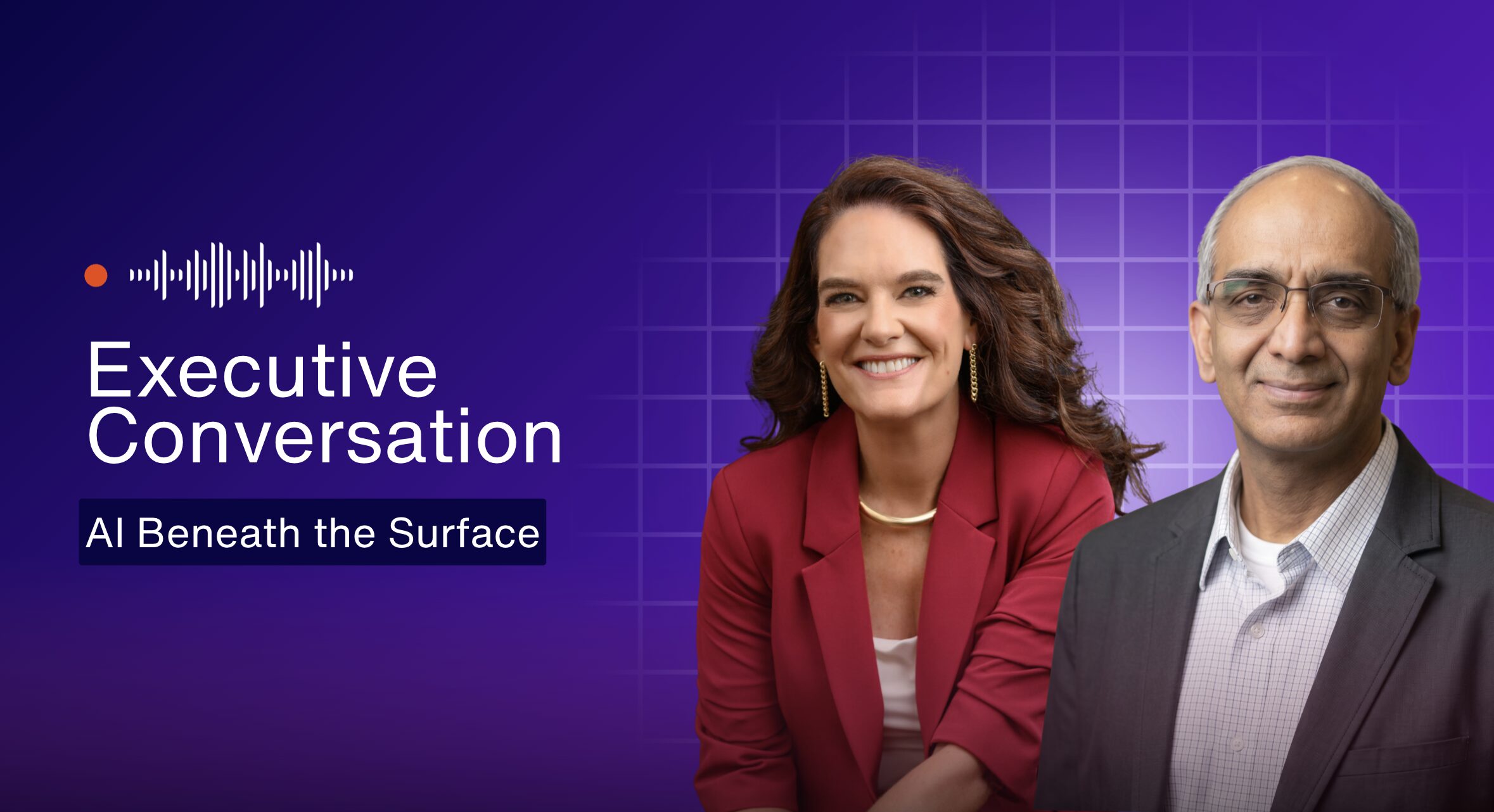
Jennifer Rouse, VP of Marketing at Autonomize AI, sits down with Laksh Krishnamurthy, CTO of Autonomize AI, to discuss the structural shifts that will define the next decade of healthcare AI.
The healthcare industry often overhypes AI “moonshots” while underestimating the structural reorganization of data and workflows occurring beneath the surface. Having built AI infrastructure for complex payer and provider environments, Laksh Krishnamurthyhas observed that success belongs to organizations disciplined about their foundation rather than those simply chasing the boldest visions. His perspective on the future of healthcare AI is grounded in this foundational shift.
JR
Jennifer Rouse
Laksh, there is no shortage of bold predictions about AI transforming healthcare. When you look ahead five to ten years, what is the most significant shift that will reshape the industry?
LK
Laksh Krishnamurthy
For more than a century, healthcare has been organized around a single event: the encounter. Patients become sick, they visit a clinician, care is documented, and the interaction ends. The next decade will be defined by a transition from episodic care to continuous care.
The fundamental issue today is that healthcare data has escaped the encounter. Wearables, remote monitoring, claims data, genomics, and social determinants of health now generate continuous signals between visits. And those signals are drowning every health system trying to act on them manually.
This is where AI can add the most value to the patient. It works not by replacing the clinician, but by sitting in the continuous layer, identifying which signals matter, determining which patients are drifting toward a bad outcome, and routing the right intervention to the right human at the right moment.
At Autonomize, we’re building toward that future. We started with administrative workflows like prior authorization and appeals, but the destination is care management and proactive intervention. The organizations that succeed won’t necessarily have better clinicians; they’ll be the ones that identify a problem weeks before it becomes an emergency room visit.
Question 2 of 5
JR
Jennifer Rouse
AI has moved beyond experimentation in many healthcare organizations. Where do you see real impact today, and where are expectations getting ahead of reality?
LK
Laksh Krishnamurthy
We’ve reached an important inflection point. AI is no longer just a collection of pilots. It is delivering measurable operational value at scale.
Today we’re seeing tangible, production-scale impact across three critical vectors: administrative efficiency, clinical decision support, and longitudinal care management. Ambient AI for documentation, automated prior authorization, and intelligent workflow orchestration are helping organizations recover clinician time and improve operational performance.
At the same time, we need to be realistic. AI remains exceptionally good at augmenting specific tasks, but comprehensive clinical reasoning remains an aspirational goal rather than a present reality. Integration with clinical systems like EHRs continues to be a significant challenge, and model accuracy alone is not a meaningful success metric if it is not firmly anchored in practical clinical utility. The goal is not to implement the best or newest model; it is to improve real-world outcomes.
AI is currently reducing administrative overhead much faster than it is transforming clinical outcomes. That’s not a limitation; it’s the foundation. Administrative efficiency creates the capacity and trust required to pursue the larger opportunity: improving outcomes for every member.
Achieving that future requires what we call Compound AI: the orchestration of multiple specialized agents, deterministic logic, and generative models working together across workflows rather than relying on a single model to do everything. This is the reason we built the Autonomize Intelligence Platform.
Question 3 of 5
JR
Jennifer Rouse
What capabilities will separate healthcare leaders from everyone else over the next decade?
LK
Laksh Krishnamurthy
Most organizations are still missing three foundational capabilities.
The first is a Unified Context Layer. Healthcare organizations have traditionally struggled to connect the “who” (the member) with the “what” (clinical knowledge needed to make decisions). AI requires more than data integration — it requires connecting real-time member signals with authoritative clinical guidance. The real magic happens when those layers come together: rather than asking AI to guess how a policy applies to a member, you create a grounded framework where AI can reason against a trusted, version-controlled source of truth.
The second is an Embedded Intelligence Layer. The most successful organizations won’t think of AI as another application users log into. AI will become invisible infrastructure embedded directly into workflows, EHRs, authorization queues, and care management systems. The future belongs to organizations that can orchestrate AI across systems rather than deploy isolated tools.
The third, and perhaps most overlooked, is Organizational AI Fluency. Success requires more than data scientists; it requires CMOs who know how to interrogate a model’s outputs, care managers who know when to trust an AI-generated summary, and CIOs who can audit for bias. The technology is increasingly accessible, but the human capability to govern it, adopt it, and improve it will be the scarce resource over the next decade.
Question 4 of 5
JR
Jennifer Rouse
Trust is becoming one of the biggest topics in healthcare AI. What does responsible AI deployment look like in practice?
LK
Laksh Krishnamurthy
Responsible AI starts with discipline. Organizations should begin with operational and administrative use cases where outcomes can be measured quickly and risk is lower. As trust and governance mature, they can progressively move toward higher-value clinical applications.
Human-in-the-loop design remains essential. AI should surface insights, identify exceptions, and recommend actions, but people should remain accountable for high-stakes decisions.
Organizations should focus on business and member outcomes rather than model metrics. Reducing denial rates, improving care coordination, and enhancing clinician productivity are far more meaningful measures of success than benchmark scores.
Equally important is establishing governance before scaling. Data lineage, auditability, compliance controls, and performance monitoring cannot be afterthoughts. For us, the Autonomize Command Center is the operational backbone of responsible AI deployment — continuously monitoring model behavior for drift, bias signals, and population-level performance degradation before they become patient safety issues.
Question 5 of 5
JR
Jennifer Rouse
If you had to leave healthcare leaders with one message about the future of AI, what would it be?
LK
Laksh Krishnamurthy
The future of healthcare AI won’t be won by organizations chasing the biggest headlines or the most ambitious moonshots.
It will be won by those who build strong foundations, integrate intelligence directly into workflows, and consistently earn trust through measurable outcomes.
The next decade belongs to organizations that combine long-term vision with operational discipline. AI’s greatest impact won’t come from replacing healthcare professionals. It will come from giving them the context, intelligence, and capacity to deliver better care at scale.
That’s the future we’re building toward at Autonomize.
Meet the Voices
Laksh Krishnamurthy is Chief Technology Officer at Autonomize AI, where he leads technology strategy, platform engineering, and product innovation to drive scalable AI solutions in healthcare. With more than 30 years of executive leadership experience across platform development and advanced analytics, he is known for automating complex data workflows, accelerating product delivery, and translating cutting-edge Generative AI into practical enterprise applications. Prior to Autonomize, Laksh held key leadership roles including VP of AI/ML Engineering at Tecnotree, Head of AI/ML Platform at CognitiveScale, and Senior Technical Staff Member at IBM. An IBM Master Inventor with 55 patent filings, he holds an M.S. in Operations Research & Computer Applications and is dedicated to fostering cultures of technological excellence.
Jennifer Rouse is Vice President of Marketing at Autonomize AI, where she leads market strategy at the intersection of healthcare, AI, and enterprise technology. With more than 20 years of experience across healthcare, cloud, cybersecurity, and enterprise technology, she previously served as Worldwide Head of Healthcare Marketing at Amazon Web Services and has held leadership roles at IBM, Cisco, and Forrester Research. Jennifer is passionate about the future of AI in healthcare, with a focus on autonomy, compliance, operational transformation, and real-world impact.
To provide the best experiences, we use technologies like cookies to store and/or access device information. Consenting to these technologies will allow us to process data such as browsing behavior or unique IDs on this site. Not consenting or withdrawing consent, may adversely affect certain features and functions.
Functional
Always active
The technical storage or access is strictly necessary for the legitimate purpose of enabling the use of a specific service explicitly requested by the subscriber or user, or for the sole purpose of carrying out the transmission of a communication over an electronic communications network.
Preferences
The technical storage or access is necessary for the legitimate purpose of storing preferences that are not requested by the subscriber or user.
Statistics
The technical storage or access that is used exclusively for statistical purposes.The technical storage or access that is used exclusively for anonymous statistical purposes. Without a subpoena, voluntary compliance on the part of your Internet Service Provider, or additional records from a third party, information stored or retrieved for this purpose alone cannot usually be used to identify you.
Marketing
The technical storage or access is required to create user profiles to send advertising, or to track the user on a website or across several websites for similar marketing purposes.