
How a single prompt transformed a regulatory monitoring challenge into a governed, enterprise-ready AI workflow.
If you’ve ever worked in healthcare operations or compliance, you’ve probably had the same thought I did: There has to be a better way to keep up with regulatory change.
Every week brings new CMS guidance, state regulations, payer policy updates, accreditation requirements, and legislative changes. Finding the updates isn’t the hard part. Figuring out what they actually mean for your organization is.
Which teams are affected? Which workflows need to change? Who needs to take action? How much risk does this create if nothing happens?
Those answers usually require a small army of compliance experts, operational leaders, clinicians, analysts, and IT teams. By the time everyone has reviewed the changes, assigned work, and updated processes, another regulation is already on the horizon.
So I decided to try something different.
The prompt
Instead of opening a project management tool or scheduling a kickoff meeting, I partnered with the development team to explore the new Autonomize Genie AI™. I was wondering if it was really as easy as I was being told it would be.
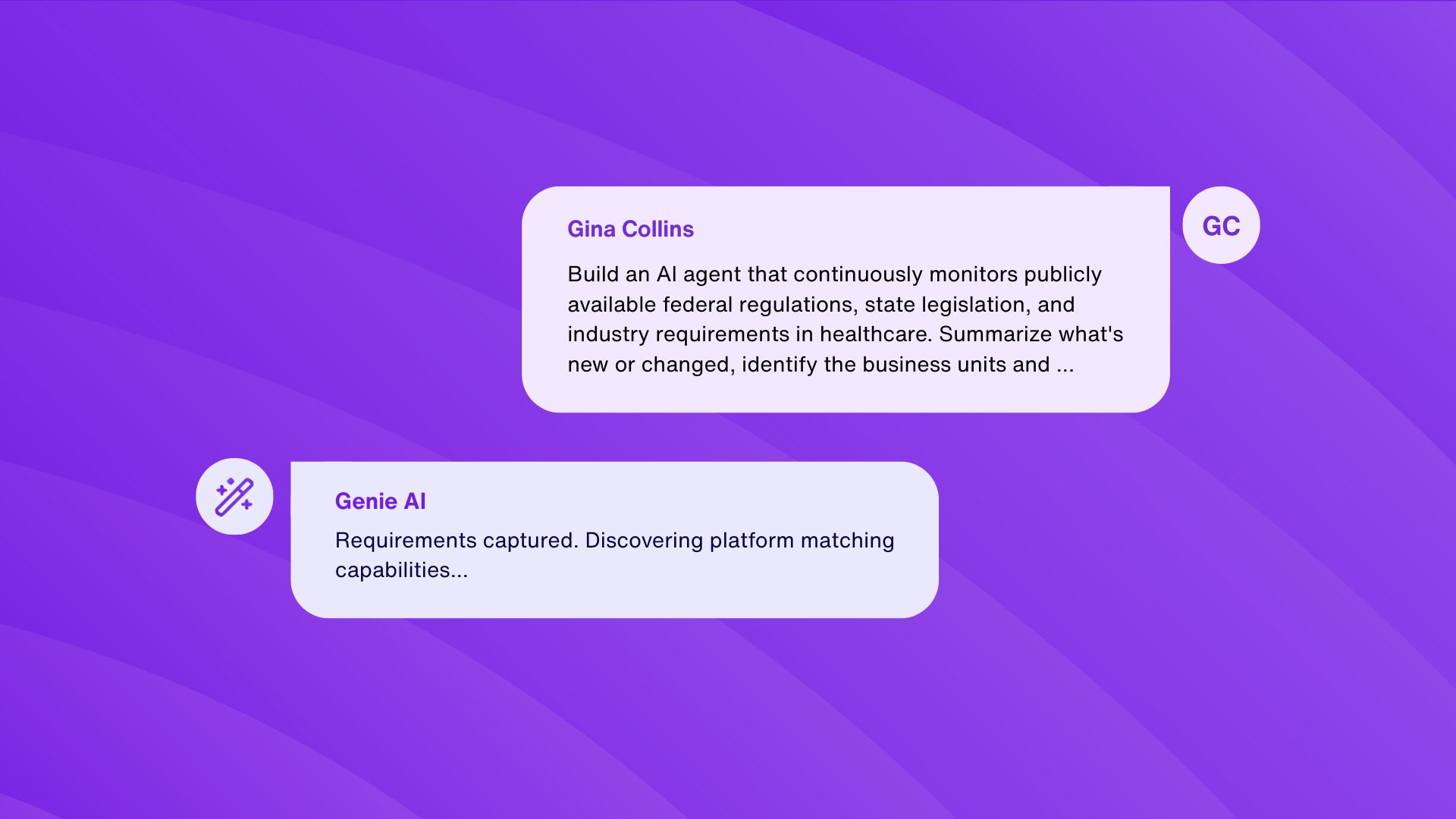
First, I typed:
“Build an AI agent that continuously monitors publicly available federal regulations, state legislation, and industry requirements in healthcare. Summarize what’s new or changed, identify the business units and workflows that could be affected, compare new requirements against our current operating procedures, recommend next steps aligned to effective and enforcement dates, notify the appropriate leaders, and track implementation until every required action is complete.”
That was it: no workflow diagrams, no coding, no technical requirements, no long drawn out technical project.
Watching Genie think like a healthcare architect
What happened next wasn’t a chatbot giving me a list of ideas. Genie started designing the solution. It recognized that regulatory monitoring would need to monitor multiple trusted regulatory sources and proposed using healthcare-native reasoning to extract new requirements and guidance instead of simply summarizing documents. It also identified where regulations could impact utilization management, prior authorization, appeals and grievances, care management, pharmacy operations, quality programs, and member services.
Then it began connecting the dots. For every regulatory update, Genie designed a workflow that would:
- Analyze what changed
- Determine which business units, workflows, and policies might be affected
- Flag potential compliance gaps
- Estimate operational impact
- Recommend actions
- Notify the right people
- Support progress tracking
In other words, it wasn’t just monitoring regulations. It was orchestrating the organization’s response.
From idea to enterprise workflow
What surprised me most wasn’t the speed. It was how much healthcare context Genie already understood. Instead of creating a disconnected automation, it assembled the regulatory monitoring using governed enterprise capabilities already available within the Autonomize Intelligence Platform:
- Approved AI agents
- Trusted data sources
- Secure integrations
- Human review points
- Governance controls
- Explainability
Everything stayed within the guardrails healthcare organizations require. That’s an important distinction. There’s a lot of excitement around AI tools that can generate applications or workflows from a prompt, and while they’re impressive, in healthcare, speed without governance creates new problems. Shadow IT, inconsistent logic, security concerns, and compliance risks can quickly outweigh the benefits.
Genie takes a different approach. Because it is built on the Autonomize Intelligence Platform™, it helps you build solutions that are ready for the enterprise from the start.
Then I started thinking bigger
Once the regulatory monitoring agent existed, my mind immediately went somewhere else. If I could build this with a single prompt, what else could healthcare organizations create?
A care management leader could build an agent that identifies high-risk members overdue for preventive care and automatically coordinates outreach. A utilization management director could redesign prior authorization workflows as payer policies change. A pharmacy team could monitor formulary updates and trigger downstream operational changes. A quality leader could create a workflow that tracks new measure specifications and identifies provider groups most likely to be affected.
The possibilities aren’t limited by technology anymore. They’re only limited by imagination.
The real breakthrough isn’t the technology
Building this type of agent without a full technology project plan was impressive, but that’s not what stuck with me. The bigger shift is who gets to innovate.
For years, healthcare organizations have depended on IT teams and consultants to translate operational ideas into technology. The people who knew where inefficiencies existed, like nurses, clinicians, compliance leaders, care managers, pharmacists, and operations teams were often several steps removed from the solution itself.
An idea would become a requirements document. The requirements document would become a project. Months later, a solution might finally be delivered. And too often, by the time it arrived, the original problem had evolved, priorities had shifted, or the solution didn’t quite work the way the frontline team envisioned. The response? Submit another ticket, request another enhancement, and start the cycle again.
Genie changes that equation.
Now the people closest to the work can describe the outcome they want in plain language and see it come to life immediately. More importantly, they don’t have to wait for the next release cycle to improve it. As they use the workflow, they can refine prompts, adjust logic, add new requirements, and continuously improve outcomes in real time. Innovation becomes iterative rather than episodic.
Instead of spending months trying to explain a problem to someone else, healthcare experts can shape the solution themselves while maintaining the governance, security, and oversight enterprise organizations require. That’s a fundamentally different model for innovation. It’s not just faster development. It’s a shift from technology being delivered to healthcare professionals to technology being co-created by the people who understand the work best.
What my experiment really represents
This isn’t just an AI agent that monitors regulations. It’s proof that healthcare expertise can now be translated directly into intelligent, governed workflows without months of development.
Today it’s regulatory monitoring. Tomorrow it’s thousands of specialized AI agents working alongside clinicians, operators, compliance leaders, and executives, sharing context, coordinating decisions, and continuously improving how healthcare operates.
When you put AI-building capabilities into the hands of the people who understand healthcare best and combine that with enterprise governance, you dramatically shorten the distance between identifying a problem and solving it.
That’s not just a faster way to build AI. It’s a new way for healthcare organizations to innovate.
Continue Learning
Learn more: Autonomize Genie AI
Learn more: Building Healthcare AI That Works in the Real World
About the Author
Gina Collins is Chief Regulatory Officer at Autonomize AI, where she leads regulatory strategy, compliance, and enterprise risk management to support safe, scalable AI adoption in healthcare. With more than 20 years of executive leadership experience across payer, provider, and government healthcare sectors, she is known for driving operational transformation, strengthening governance, and translating complex regulatory requirements into practical solutions. Prior to Autonomize, Gina held leadership roles at the FDA’s Center for Devices and Radiological Health and a Fortune 13 global health services company, leading initiatives focused on regulatory transparency, operational risk, and compliance.