NCQA Recap: What Health Plans Are Really Worried About
- October 9, 2026
Malorie Guerrero, RN, MSN
Clinical AI Program Manager
I just got back from an intense, eye-opening week at NCQA, and if there’s one overriding takeaway I brought home, it’s this: the healthcare industry is eager to embrace digital transformation, but almost everyone feels like they’re flying without a navigation system.
As a clinician who works side-by-side with machine learning engineers every single day, walking through the halls at NCQA was both validating and energizing. Between the Digital HEDIS workshops, the hands-on AI focus groups, and a 1:1 conversation with NCQA leadership, it became crystal clear that our clinically led, validation-first approach isn’t just nice to have: it’s exactly what the market is desperately asking for.
Here is my recap of what went down, where payers are struggling, and why I’ve never been more excited about the work we’re doing at Autonomize.
Day 1: Digital HEDIS and the 2030 Countdown
The room was packed for the Digital HEDIS workshop, where NCQA walked us through program updates, live demonstrations of Clinical Quality Language (CQL) logic, and the roadmap leading up to the 2030 transition to full digital measurement.
While the tech demonstrations were impressive, the Q&A session exposed the raw anxiety in the room. Payers were incredibly candid about where they stand:
Data Infrastructure Frustrations: Many organizations simply aren’t sure their legacy systems can support true digital measurement or handle FHIR/CQL readiness.
Invisible Quality Gaps: There’s widespread fear about what blind spots will suddenly be revealed once measures start running digitally.
Planning Against a Moving Target: Between evolving measure requirements and technical uncertainties, health plans feel like they’re trying to build a foundation on shifting sand.
The consensus? The industry knows where it needs to go by 2030, but the bridge to get there safely is still being built.
Day 2: AI Focus Groups & Raising the Bar for Clinical Governance
Day 2 kicked off with AI focus groups centered on safe rollout practices and technology built around real workflows. Hearing NCQA highlight the Prior Authorization (PA) case study we completed together made me proud to be part of an organization helping put these principles into practice in healthcare.
We broke out into small working groups to map the risks, mitigations, and benefits of bringing AI into clinical workflows. When we looked across the room, the anxiety around AI boiled down to a few major themes:
Tech Literacy
Teams don’t fully understand how these AI models work or how to evaluate vendor claims.
Data Protection
Severe, justified anxiety around patient privacy and HIPAA compliance.
Hallucinations & Missed Details
Fear that models will make things up or miss critical clinical context when pulling from complex patient records.
Lack of Governance
A burning desire for real oversight frameworks that most vendors simply aren’t providing.
Only one other AI vendor was present in our focus group. They spoke eloquently about building slick software, but when it came to how they actually validate or safely release models into the wild, the room went quiet.
That was my cue to step up.
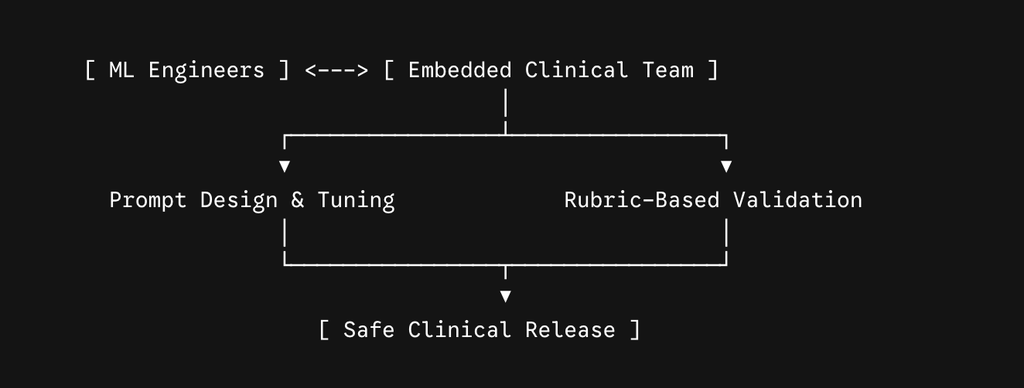
I walked the group through how we do things at Autonomize. We don’t just build an algorithm and hand it over to a doctor to figure out; our clinical team is deeply embedded in the engineering process.
When I explained how our multidisciplinary clinical bench co-designs prompts with ML engineers and subjects every output to rigorous, rubric-based clinical validation before anything ships, you could feel the collective exhale in the room.
Here is how our clinical approach directly solves what keeps payers up at night:
Payers’ Top Concerns
How We Address It at Autonomize
Hallucinations
Rubric-based clinical validation catches unsupported outputs before code is ever released.
Missed Data Extractions
Clinicians audit extraction completeness against real-world clinical relevance.
Lack of Governance
A repeatable, documented sign-off process translates “governance” from a buzzword into daily practice.
Low Tech Literacy
Clinicians fluent in both patient care and data science bridge the gap between engineering and care teams.
Patient Data Fears
Clinical ownership ensures patient safety and ethical handling stay at the heart of the release pipeline.
My 1:1 with NCQA: The “Pre-Data Readiness” Breakthrough
To cap off the event, I had the opportunity to sit down 1:1 with Bobby Minatra from NCQA. We talked candidly about the industry’s friction points, including data mapping issues, CQL/FHIR hurdles, and complete data quality gaps.
I shared the results of our recent HEDIS experiment, demonstrating how clinical oversight can catch data anomalies early. That sparked an exciting takeaway: NCQA sees a massive opening for our clinical expertise in “pre-data readiness.”
Instead of waiting until measures run and catching errors after the fact, there is an immediate opportunity to position our platform as a verification layer on top of HEDIS engines. By auditing and validating data before it hits the measurement engine, we can help payers identify discrepancies at the source.
Looking Ahead
Walking away from NCQA 2026, I felt immensely proud of our team. The market doesn’t just need faster AI; it needs trustworthy, clinically governed systems built by people who understand the gravity of a medical record.
We’re proving that when clinicians and engineers build together, you don’t have to compromise between cutting-edge innovation and patient safety. I can’t wait to show you what we’re building next!
About the Author
Malorie Guerrero, RN, MSN, bridges the gap between patient-centered care and artificial intelligence as Clinical AI Program Manager at Autonomize AI. Drawing on her clinical background across Oscar Health, HCA Healthcare, and Centene Corporation, she works side-by-side with engineers to build safe, clinically-validated tools. Deeply respecting the reality of everyday caregiving, Malorie translates complex tech into practical solutions that work in the real world, protect patient safety, and bring true trust back to digital health.
To provide the best experiences, we use technologies like cookies to store and/or access device information. Consenting to these technologies will allow us to process data such as browsing behavior or unique IDs on this site. Not consenting or withdrawing consent, may adversely affect certain features and functions.
Functional
Always active
The technical storage or access is strictly necessary for the legitimate purpose of enabling the use of a specific service explicitly requested by the subscriber or user, or for the sole purpose of carrying out the transmission of a communication over an electronic communications network.
Preferences
The technical storage or access is necessary for the legitimate purpose of storing preferences that are not requested by the subscriber or user.
Statistics
The technical storage or access that is used exclusively for statistical purposes.The technical storage or access that is used exclusively for anonymous statistical purposes. Without a subpoena, voluntary compliance on the part of your Internet Service Provider, or additional records from a third party, information stored or retrieved for this purpose alone cannot usually be used to identify you.
Marketing
The technical storage or access is required to create user profiles to send advertising, or to track the user on a website or across several websites for similar marketing purposes.