A Nurse’s Take on HLTH 2026: Why AI Agents Need Deeper Context
- November 24, 2026
Malorie Guerrero, RN, MSN
Clinical AI Program Manager
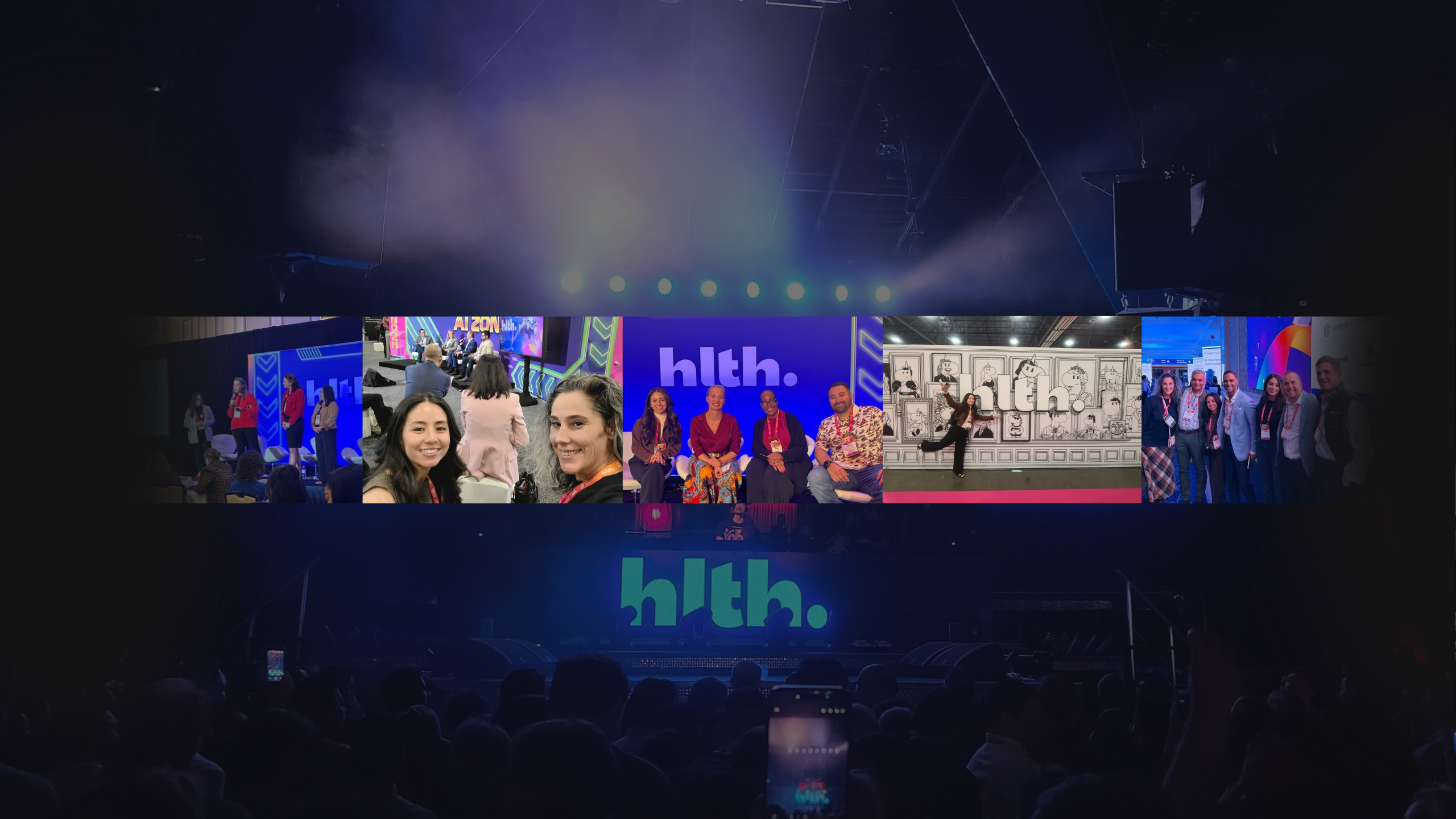
I’ve spent a lot of my career translating between the bedside and the systems built to support it. So when Aimee Oldaker, one of our Clinical AI Program Leads, and I headed to HLTH in Las Vegas this year, we went with a simple goal: look at healthcare AI the way a clinician would.
We sat in sessions, walked the exhibit hall, and competed in the Nurse Hackathon. But some of the best parts of the week were the conversations Aimee and I had in between. Over coffee, walking the floor, at dinner, we kept circling back to the same question.
Everyone at HLTH was talking about context. But what does context actually mean to a nurse?
By the end of the week, we had our answer. Our agents don’t need more data. They need the clinical meaning we strip out before the data ever reaches them.
The Idea That Started It All: Lossy Compression
One session gave us language for something we’d both felt for years. The speaker called it lossy compression: the clinical meaning we lose when rich information gets squeezed into a simpler form.
Aimee turned to me and brought up PHQ-9. In so many systems, the depression screening gets recorded as one total score. But the individual answers carry the real story. Two patients can land on the exact same number and need completely different responses. One might be struggling with sleep and energy. Another might have answered the question about thoughts of self-harm. Same score, very different afternoon for the care team.
My mind went straight to lactate. Picture an agent reviewing a hospital record. It sees three lactic acid draws and logs them as three lab results. A nurse sees something else entirely. Repeated lactate orders mean the team is worried about sepsis. The pattern of the orders is itself the signal, and it’s one any experienced nurse would catch in a heartbeat.
In both cases, the information is technically there. It’s just been documented or ingested in a way that strips out the part that matters most.
The ICU: The Most Data and The Least Context
The more we talked, the more we kept landing in the ICU, because that’s where this problem is at its biggest.
Arterial lines, ventilators, and infusion pumps generate continuous, high-resolution data all day and all night. But the clinical record usually keeps only periodic validated values, often hourly.
Think about what gets left behind:
The arterial line. The waveform can show pulse pressure variation that tells you whether a ventilated patient is likely to respond to fluids. The chart shows a blood pressure.
The ventilator. Its waveforms can reveal patient-ventilator dyssynchrony or air trapping well before anyone documents a settings change.
The infusion pump. Its history shows how many times a nurse titrated a vasopressor overnight. That can say more about how unstable a patient is than any single charted rate.
The bedside team sees all of this in real time. We feel it. But by the time it reaches the record, and by extension our AI agents, most of that context is gone.
The Context No One is Collecting
Aimee pushed our conversation one step further. Lossy compression isn’t only about information we capture and then flatten. It’s also about information that’s right in front of us that our systems never gather at all.
Take virtual patient monitoring. Today it can flag when a patient is moving or has fallen. That matters. But a nurse watching that same patient would notice so much more: accessory muscle use, tripoding, the work of breathing creeping up. Those are early signs of respiratory distress, and they’re visible. The camera sees exactly what the nurse sees. The system just isn’t looking for it.
Voice is another one. Researchers at Bern University Hospital recently published a study in Diabetes Care showing that a machine learning model could detect low blood sugar from smartphone voice recordings in around 90 percent of cases when participants read text aloud. It was a small study, just 22 people with type 1 diabetes in a controlled setting, so it’s early evidence, not something ready for the floor. But it shows how much clinical signal is hiding in places our tools currently ignore.
What Deep Context Looks Like For An AI Agent
So what do we do with all of this? Aimee and I flew home with a pretty clear picture of what it means to give an agent real clinical context.
Start at the point of ingestion. Every agent we build should be reviewed for what clinical meaning gets lost the moment data comes in. Is it reading a total score when it should be reading the answers? Is it counting labs when it should be noticing a pattern?
Look for patterns, not snapshots. Order trends, item-level assessment answers, and changes over time often tell the real story. Summary values and simple event flags rarely do.
Learn to see what a nurse sees. Over time, there’s a real opportunity for agents to pick up on observable signs, like visual or vocal cues of deterioration, instead of waiting for them to show up in a charted value.
Then prove the context survived. This is the piece I care about most. A big part of my focus right now is taking our clinical validation process to the next level and finding ways to scale it. If clinicians define what an agent needs to know, clinicians also have to check that the agent is actually using it, and using it correctly. Strong governance is what turns deep context from a nice idea into something a care team can trust.
None of this works without clinicians who have done the work. You can only specify the context an agent needs if you know what an experienced nurse would notice. You learn that by standing at the bedside, not by reading about it.
The Nurse Hackathon: Context in Action
If I needed proof that nurses belong at the center of this work, Tuesday morning delivered it.
The Nurse Hackathon brought together about 17 teams of nurses to tackle real problems they face on the job. Each team had 90 minutes to build a concept, a pitch deck, and a prototype before presenting to the judges. No polished startup idea required. Just a frontline problem and the people who live it every day.
My team was a wonderful mix of nurses from care management, nursing informatics, entrepreneurship, and other specialties. We zeroed in on a problem that weighs on rural communities across the country: getting clinicians and care resources to the clinics and hospitals that need them most. Today that process is slow and cumbersome for everyone involved.
So we designed an automation platform to connect the two. A clinician uploads a resume, and the platform builds their profile automatically. From there, it helps them find openings in rural communities and compare the incentive packages for each one. We built a working prototype of the application experience, modeled on something like TurboTax, and backed it with a business case tied to new federal rural health funding. We made sure the clinical value was front and center, and that it worked for clinicians and for hospitals’ bottom lines.
We took first place. I’m still smiling about it.
Aimee’s team was in the room too, working on a completely different problem. A travel nurse told them perioperative onboarding felt inadequate, and in those same 90 minutes they designed an AI preceptor: a training tool that prepares new OR staff before they ever step into the operating room, adapts national competencies to each hospital’s protocols, and reports strengths and gaps to a human preceptor who makes the final call.
That’s what happens when the people who know what gets lost in a workflow are the ones designing the fix.
Looking Ahead
HLTH reminded me how fast this space is moving. Every year the models get more capable and the data gets richer. But capability isn’t the same as understanding. The signal that matters most to patients is often the part we’re quietly throwing away.
Aimee and I came home energized, and our conversations haven’t stopped. Our clinical team is going to keep asking the bedside questions: what would a nurse notice here, what are we losing, and how do we prove our agents see it too. I can’t wait to share what we build next.
About the Author
Malorie Guerrero, RN, MSN, bridges the gap between patient-centered care and artificial intelligence as Clinical AI Program Manager at Autonomize AI. Drawing on her clinical background across Oscar Health, HCA Healthcare, and Centene Corporation, she works side-by-side with engineers to build safe, clinically-validated tools. Deeply respecting the reality of everyday caregiving, Malorie translates complex tech into practical solutions that work in the real world, protect patient safety, and bring true trust back to digital health.
To provide the best experiences, we use technologies like cookies to store and/or access device information. Consenting to these technologies will allow us to process data such as browsing behavior or unique IDs on this site. Not consenting or withdrawing consent, may adversely affect certain features and functions.
Functional
Always active
The technical storage or access is strictly necessary for the legitimate purpose of enabling the use of a specific service explicitly requested by the subscriber or user, or for the sole purpose of carrying out the transmission of a communication over an electronic communications network.
Preferences
The technical storage or access is necessary for the legitimate purpose of storing preferences that are not requested by the subscriber or user.
Statistics
The technical storage or access that is used exclusively for statistical purposes.The technical storage or access that is used exclusively for anonymous statistical purposes. Without a subpoena, voluntary compliance on the part of your Internet Service Provider, or additional records from a third party, information stored or retrieved for this purpose alone cannot usually be used to identify you.
Marketing
The technical storage or access is required to create user profiles to send advertising, or to track the user on a website or across several websites for similar marketing purposes.